

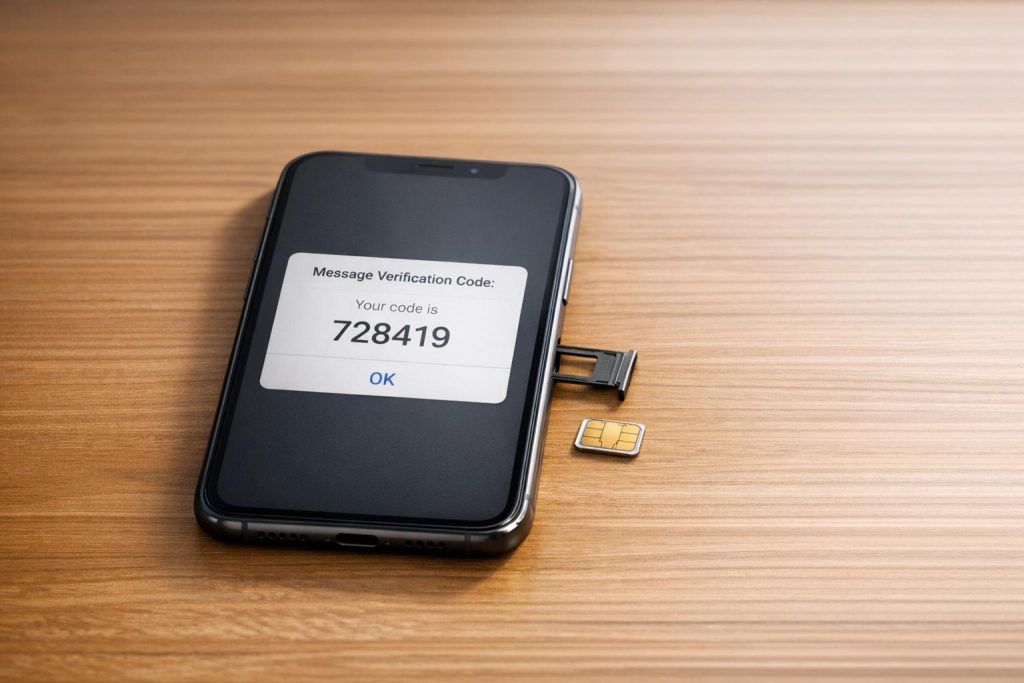
Your verification code isn’t arriving, and here’s why: Free VoIP numbers are flagged by most platforms as unreliable for security reasons. These numbers often fail due to recycled usage, spam associations, and lack of a physical SIM card. By 2026, 70–80% of major platforms block VoIP numbers outright, especially banks, social media, and e-commerce sites.
The fix? Switch to SIM-based non-VoIP numbers. These numbers are classified as "MOBILE" in carrier databases, ensuring a 95–99% success rate for receiving verification codes. Platforms trust these numbers because they’re tied to physical networks, unlike VoIP numbers routed through the internet.
Key Takeaways:
- VoIP numbers fail due to shared use, spam flags, and platform security filters.
- Banks and social media apps block VoIP numbers for fraud prevention.
- Non-VoIP numbers work reliably across platforms and ensure fast code delivery.
If you’re tired of failed verifications, non-VoIP numbers are the solution. They’re easy to set up and work seamlessly across all major platforms.
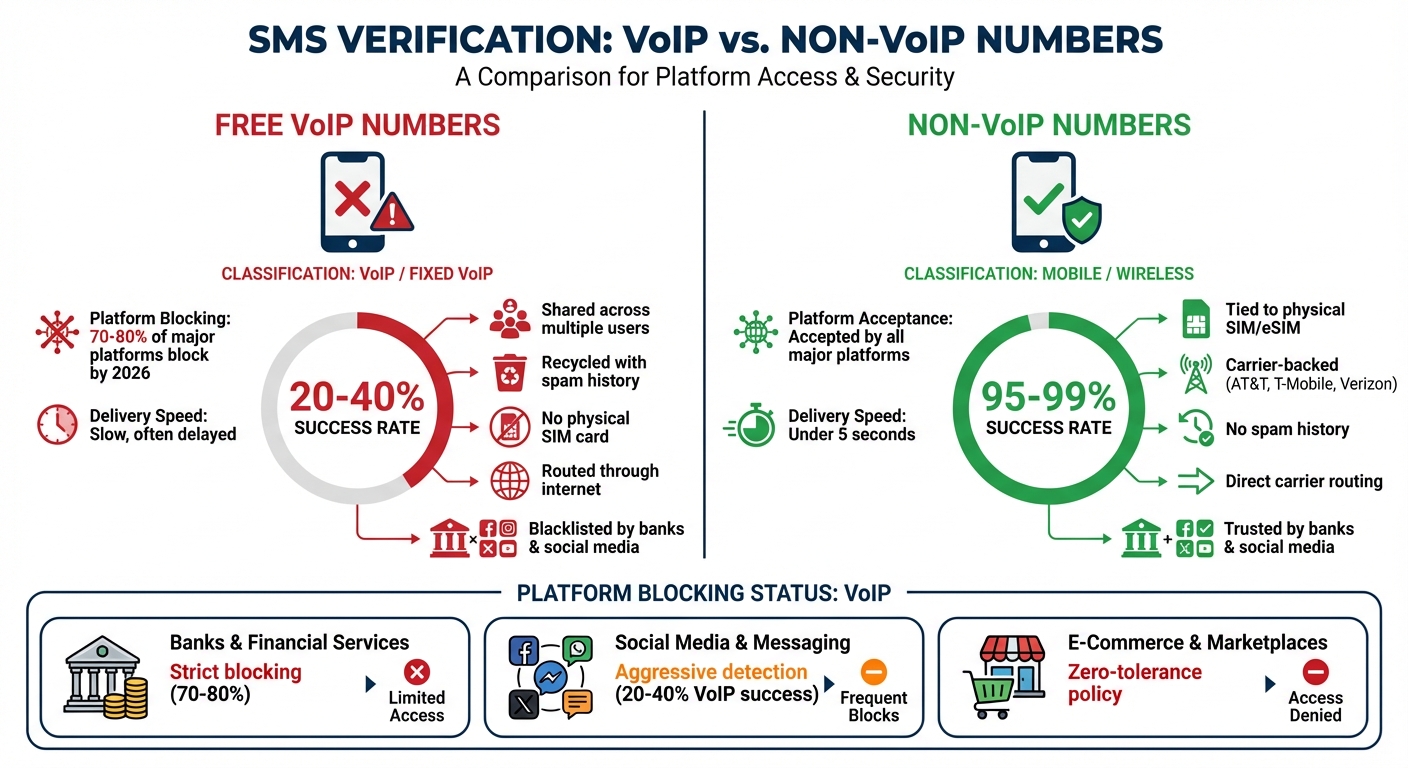
VoIP vs Non-VoIP Numbers: Success Rates and Platform Acceptance Comparison
How Anti-Abuse Filters Block Free VoIP Numbers
When you request a verification code, platforms don’t just send it without a second thought. Instead, they rely on advanced systems to verify the legitimacy of your number in mere milliseconds – often rejecting VoIP numbers outright.
How Carriers Detect and Block VoIP Traffic
Every phone number carries unique identifiers, like the Mobile Country Code (MCC) and Mobile Network Code (MNC), which reveal the network operator tied to that number. Real mobile numbers are linked to carriers like Verizon or AT&T, while VoIP numbers are associated with virtual providers such as Twilio or Google Voice.
To classify these numbers, platforms use Line Type Intelligence databases, which sort numbers into categories like mobile, landline, fixedVoip, or nonFixedVoip. For example, in July 2022, Twilio showcased their Lookup API by identifying their own customer support number (+18448144627) as a nonFixedVoip number. The API flagged the carrier as "Twilio – Toll-Free", allowing platforms to block one-time passcodes from being sent to it.
Mobile apps can also detect when a phone number lacks a physical SIM card or a cellular connection (like LTE or 5G). Numbers missing these elements are flagged immediately. Additionally, VoIP messages are routed through internet relays rather than direct carrier SMSC routes. This creates delays, inconsistent sender IDs, and other signs that platforms use to identify and block VoIP traffic.
These carrier-level detection methods form the backbone of the strict policies platforms enforce.
Platform-Level VoIP Blocking Policies
Banks, social media platforms, and e-commerce websites have implemented highly automated systems to identify and block VoIP numbers. By 2026, it’s estimated that 70% to 80% of major platforms will actively block VoIP numbers using real-time carrier lookup databases. When you submit a number for verification, these platforms check its type instantly. If the response indicates "VoIP" or "Fixed VoIP", the platform may silently reject the SMS delivery.
Financial institutions, including payment processors and crypto exchanges, are especially strict, often rejecting VoIP numbers across the board. WhatsApp has gone even further, blocking not only VoIP numbers but also landlines and toll-free numbers. On major platforms with fraud detection measures, VoIP numbers see delivery success rates of just 20% to 40%, compared to the 95% to 99% success rate of SIM-based mobile numbers. Even when VoIP codes are delivered, they often take much longer – far exceeding the typical under-5-second delivery time of mobile codes.
sbb-itb-5a89343
Why Shared Numbers Get Blacklisted
VoIP services often reuse the same numbers across multiple users – sometimes dozens or even hundreds. This practice leads to verification failures and undermines the reliability of these numbers. Let’s break down how high usage limits and recycling contribute to this problem.
What Happens When Too Many People Use the Same Number
Most major platforms cap the number of verifications per day at 3–5 per number. When VoIP numbers are shared among many users, these limits can be exceeded in just hours – or even minutes. Once this threshold is crossed, it triggers security flags. Banks and financial institutions, in particular, are quick to blacklist entire ranges of numbers linked to VoIP providers due to the high volume of automated abuse. Unfortunately, even first-time users can find themselves blocked simply because their number belongs to a flagged range.
How Recycled Numbers Inherit Spam Flags
VoIP providers often reassign numbers after short cooling-off periods. This means that a "new" VoIP number may carry a history of spam flags, fraud alerts, or even account bans from its previous user.
"Platforms don’t just block known VoIP providers. They query carrier databases that identify line types at the infrastructure level. A number either originates from a mobile network or it doesn’t – there’s no middle ground." – VoidMob
Some platforms, like X (formerly Twitter), take it a step further by checking the history of numbers linked to an account. If your recycled number was previously tied to banned accounts or suspicious activity, your verification attempt could fail instantly – even if you’ve never used the number before. This inherited reputation explains why a VoIP number that worked yesterday might stop working today. These challenges are especially problematic in critical sectors, highlighting where free VoIP numbers often fall short.
Where Free VoIP Numbers Fail Most Often
Understanding the limitations of free VoIP numbers can save you from unnecessary hassles, like account lockouts or failed verifications. Different platforms have their own restrictions, and some are stricter than others.
Banks and Financial Services
Banks are notorious for their tough stance on VoIP numbers. When you try to set up an account, they use carrier databases to verify the type of phone line. If the system identifies your number as "VoIP" or "Fixed VoIP" instead of "MOBILE", your verification attempt is immediately blocked – often without any error message.
Why are banks so strict? Fraud prevention. VoIP numbers are easily acquired in bulk and don’t require in-person verification, making them a favorite tool for fraudsters. Even if a VoIP number works initially, banks may flag or suspend your account later during routine fraud checks. By 2026, 70-80% of major financial platforms will actively block VoIP numbers using these carrier lookup systems.
Social Media and Messaging Apps
Apps like WhatsApp, Instagram, and Telegram are even more aggressive when it comes to detecting VoIP numbers. Their primary goal is to combat spam bots, automated account creation, and fake followers – problems often tied to free SMS verification numbers. These platforms don’t just rely on carrier databases; they also check for physical SIM cards and cellular signals (LTE/5G) through device telemetry. Without these signals, VoIP numbers are flagged and blocked almost instantly.
The success rates highlight the issue: VoIP numbers only work 20-40% of the time on major social platforms, compared to 95-99% success rates for SIM-based numbers. Even if a VoIP number initially passes, your account could still face suspension during later fraud sweeps – potentially costing you followers, connections, or business opportunities.
Online marketplaces face similar challenges with VoIP numbers.
E-Commerce Sites and Online Marketplaces
Marketplaces like Amazon and eBay rely heavily on phone verification to maintain trust and prevent fraudulent activity. Their systems go beyond just identifying the line type. They also check the carrier name and whether the number comes from a Tier-1 carrier like AT&T or Verizon. Numbers from aggregators are flagged immediately.
These platforms also run additional checks, such as matching your phone number’s region to your IP address, location, and device metadata. If there’s any inconsistency, your SMS code might be silently rejected. Since VoIP numbers are often used to create fake seller accounts or manipulate reviews, e-commerce sites have adopted a zero-tolerance policy toward virtual numbers in their verification processes.
The Fix: Switch to Non-VoIP Numbers
The solution to avoiding the pitfalls of free VoIP numbers is simple: switch to SIM-based non-VoIP numbers for dependable verification. These numbers are tied to cellular networks through physical SIM or eSIM cards, just like the ones you’d get from providers such as AT&T, T-Mobile, or Verizon. The best part? You can access these non-VoIP numbers via a dashboard or API – no need for an actual phone.
Why Non-VoIP Numbers Perform Better
Non-VoIP numbers are labeled as "MOBILE" or "WIRELESS" in carrier lookup databases, meeting the security standards required by banks, social media platforms, and online marketplaces. This classification is why they achieve an impressive 95–99% success rate across platforms, compared to the 20–40% success rate of VoIP numbers on stricter systems.
Because these numbers use the same network infrastructure as regular mobile lines from major carriers, they are indistinguishable from standard personal phone numbers. For a more detailed explanation, check out this technical guide on improving SMS success rates with non-VoIP numbers. Using non-VoIP numbers ensures compliance with carrier security protocols and significantly boosts your verification success.
How to Secure a Non-VoIP Number
Getting a non-VoIP number through MobileSMS.io is quick and straightforward. Sign up for an account, add credits (starting with a $5 minimum), and you’re ready to go. For one-time verifications, choose the single-use option starting at $3.50 per SMS. Need longer access? Opt for rental plans that cater to ongoing needs.
From the dashboard, select your country and preferred rental plan. You can choose a 7-day rental for short-term use or a 30-day rental that auto-renews for continuous access. The "All Services" plan supports over 1,200 platforms – just hit "Activate" in the dashboard to get your verification codes. For team workflows, the All Services Premium plan delivers codes directly to Slack or Discord. Numbers are typically available in your account within minutes. Learn how to get a reliable non-VoIP number and avoid the hassle of blocked verifications.
Pro tip: Use tested VPN and proxy services to match your IP address with the country of your phone number. Many platforms check for this consistency, and mismatches – even with legitimate non-VoIP numbers – can raise fraud alerts.
Conclusion
Verification issues arise because of strict security measures and multiple filters. Free VoIP numbers are often flagged as "VoIP" or "Fixed VoIP" in carrier lookup databases, leading 70–80% of major platforms to reject them before verification codes even reach you. On top of that, shared-number blacklists and recycled spam flags further lower the success rate to just 20–40%, causing repeated failures.
Banks, social media platforms, and e-commerce sites view VoIP numbers as potential security risks due to their link to automated abuse. Even if a free VoIP number works temporarily, platforms often conduct retroactive fraud checks that could suspend your account weeks or even months later.
The solution? Non-VoIP numbers from major carriers like AT&T, T-Mobile, or Verizon. These numbers are classified as "MOBILE" or "WIRELESS" in carrier databases, offering a 95–99% acceptance rate across platforms. They deliver verification codes in under five seconds, avoiding silent rejections and reducing the risk of account bans.
If you’re tired of dealing with failed verifications, switch to a reliable non-VoIP number. Whether you need a one-time number for $3.50 or a 30-day rental for ongoing use, carrier-backed numbers ensure hassle-free verification every time.
FAQs
How can I tell if my number is VoIP or MOBILE?
You can figure out whether a number is VoIP or mobile by using online tools designed to analyze its carrier and line type. These tools access telecom databases to determine if a number is VoIP, landline, or mobile. VoIP numbers operate through the internet and are frequently restricted by platforms, whereas mobile numbers, linked to physical SIM cards, are considered more dependable for SMS verification.
Why did my VoIP number work before but stop now?
Platforms are cracking down on VoIP numbers for SMS verification, relying on carrier databases and detection tools to flag internet-based numbers. This is done to reduce misuse, but it often means your verification codes might never arrive. To avoid this issue, switching to a non-VoIP number can provide more reliable SMS delivery.
Will a non-VoIP number work with banks and WhatsApp?
Yes, non-VoIP numbers are more likely to be accepted by banks and WhatsApp because they are tied to physical SIM cards. These numbers are typically recognized as more reliable by such platforms, unlike VoIP numbers, which are frequently blocked due to anti-abuse policies.