

MySudo and burner numbers both aim to staying anonymous online, but they serve different needs. MySudo offers long-term privacy management with up to nine digital identities, each including a phone number, encrypted email, private browser, and virtual payment card. It’s subscription-based, starting at $0.99/month, and provides end-to-end encryption for secure communication between users.
Burner numbers, on the other hand, are short-term solutions for temporary anonymity. These can be virtual VoIP numbers from apps like Burner or Hushed, physical prepaid phones, or temporary SIM cards. They’re often cheaper (some even free) but lack encryption and additional tools like email or payment features.
Key Differences:
- MySudo: Best for managing multiple aspects of your life securely over the long term.
- Burner Numbers: Ideal for quick, disposable use, like selling items online or dating apps.
Quick Comparison
| Feature | MySudo | Burner Numbers |
|---|---|---|
| Purpose | Long-term privacy management | Short-term anonymity |
| Encryption | End-to-end (Sudo-to-Sudo) | None |
| Additional Tools | Email, browser, payment cards | None |
| Cost | $0.99–$9.99/month | $4.99/month or $25 lifetime |
| Ease of Use | Complex (multiple identities) | Simple (create, use, discard) |
Choose MySudo for comprehensive privacy or burner numbers for quick, temporary use.
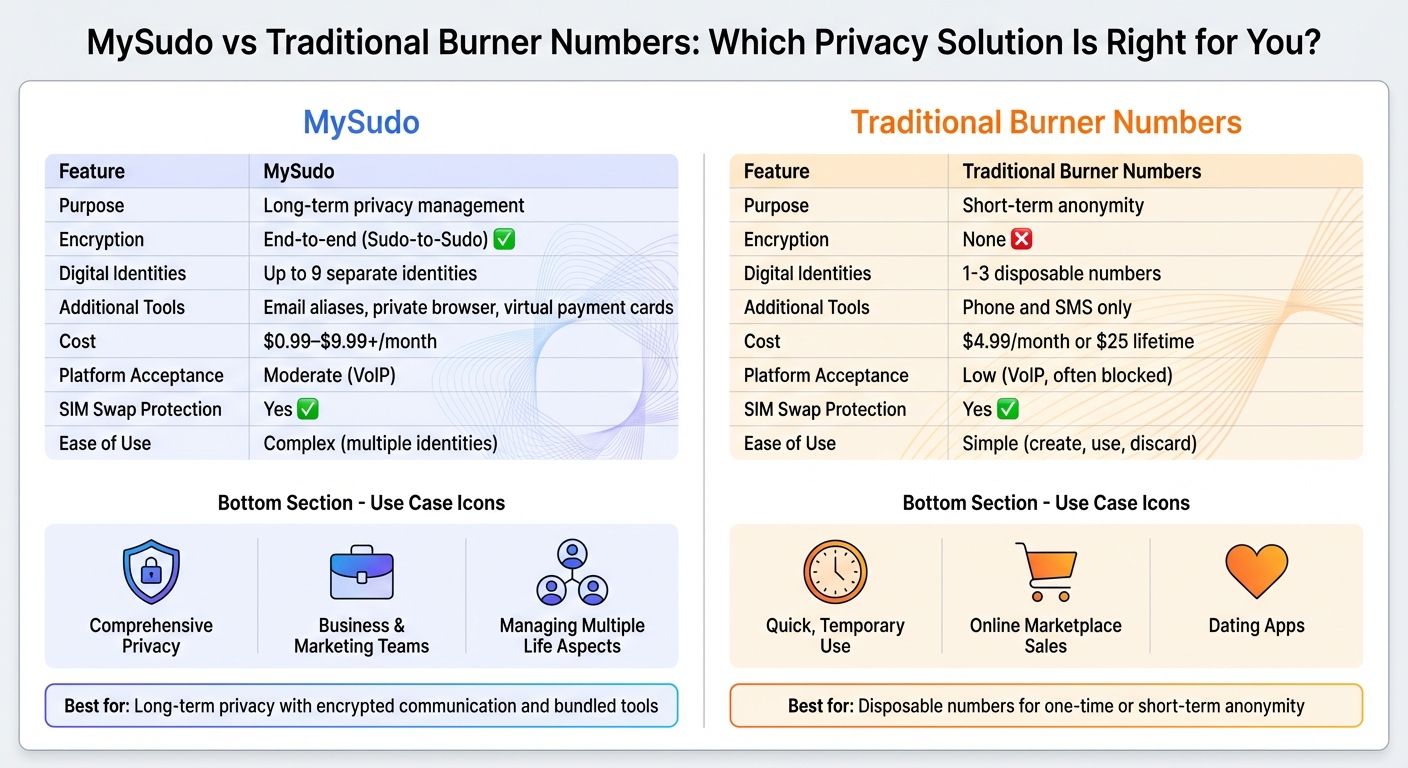
MySudo vs Traditional Burner Numbers: Feature Comparison Chart
Feature Comparison
Privacy and Security
MySudo goes above and beyond when it comes to protecting your conversations. It uses end-to-end encryption (E2EE) for all messages, voice calls, and video chats between MySudo users. This ensures that your communication remains private – scrambled during transit and inaccessible to third parties. In contrast, traditional burner apps typically rely on standard SMS and voice protocols, which lack encryption and are vulnerable to interception. MySudo’s VoIP system also shields you from SIM swap attacks, a risk often associated with carrier-managed minutes used by burner apps.
"Traditional phone calls are not encrypted; VoIP and secure calling apps like MySudo use E2EE to prevent interception or unauthorized recording." – Anonyome Labs
Beyond messaging, MySudo offers a private browser for each identity. This browser isolates cookies and caches, blocking trackers from piecing together your online activity across different Sudos. On top of that, MySudo integrates virtual payment cards and email aliases into each identity – features you won’t find in most burner services. These added layers of protection make MySudo a standout choice for managing your digital footprint.
Flexibility and Ease of Use
When it comes to flexibility, MySudo is designed for long-term use, allowing you to create and manage up to nine separate phone numbers on one device. Each number is tied to a distinct digital identity, making it easy to compartmentalize different aspects of your life – whether it’s work, dating, shopping, or other activities.
On the other hand, traditional burner apps like Burner and Hushed are built for short-term, disposable use. Burner, with over 5 million downloads on Google Play, offers temporary numbers that can be discarded when no longer needed. Similarly, Hushed, which supports numbers in over 300 area codes and has 8 million users worldwide, focuses primarily on voice and SMS services. However, these apps lack the additional tools – like private browsers and virtual payment cards – that MySudo provides. While both options serve different needs, MySudo’s array of features makes it easier to manage multiple identities securely.
Platform Acceptance
Both MySudo and traditional burner apps rely on VoIP technology, meaning their numbers are classified as virtual rather than carrier-based. MySudo markets its numbers as "real, unique, working phone numbers", suitable for various activities such as signing up for services, online dating, or even Craigslist transactions. This makes them a practical choice for users who want privacy without sacrificing functionality.
That said, some platforms – particularly financial services and certain social media sites – have started rejecting VoIP numbers for account verification. This limitation affects both MySudo and traditional burner apps, as they depend on internet-based telephony. Currently, MySudo numbers are available in the US, Canada, and the UK (with UK numbers requiring identity verification), while Burner operates solely in the US and Canada.
Pros and Cons
This section breaks down the key strengths and weaknesses of each approach to digital privacy.
MySudo: Advantages and Disadvantages
MySudo stands out for its ability to create up to nine separate digital identities – each with its own phone number, email address, and browser. This compartmentalization ensures that a breach in one identity doesn’t compromise your entire digital footprint. It also offers end-to-end encryption for Sudo-to-Sudo communication, meaning even MySudo can’t access your calls or messages. Plus, by using VoIP, it reduces the risk of SIM swap attacks.
"MySudo takes privacy to another level by creating complete digital identities (Sudos) rather than just phone numbers." – Temporary.Best
That said, managing multiple identities can become overwhelming, especially when juggling notifications across several Sudos. The app operates on a subscription model, with plans starting at $0.99/month for SudoGo (1 number, 100 messages, 30 minutes of talk time) and going up to SudoMax for more extensive needs (9 numbers, unlimited messaging, and calls). Unlike some burner apps that allow one-time purchases, MySudo requires continuous payments to maintain active numbers. Another drawback is that if you delete a number, it still counts toward your plan’s lifetime limit unless you pay for a "line reset."
Now, let’s look at how traditional burner numbers compare in terms of simplicity and affordability.
Traditional Burner Numbers: Advantages and Disadvantages
Traditional burner apps like Burner and Hushed shine in their simplicity. They’re perfect for quick, disposable use – just create a number, use it, and discard it when it’s no longer needed. Hushed even offers a lifetime plan for $25, making it a cost-effective choice for occasional users. For those on a tight budget, TextNow provides a free, ad-supported tier for numbers in the US and Canada.
However, these apps have notable security shortcomings. Communications rely on standard SMS and voice protocols, which lack encryption. They also expose metadata – like call duration, location, and participants – which can be accessed through subpoenas. Unlike MySudo, traditional burner apps don’t include extra privacy tools like email aliases, virtual payment cards, or private browsers. They typically focus solely on providing a disposable phone number.
Side-by-Side Comparison Table
| Feature | MySudo | Traditional Burner Apps |
|---|---|---|
| Primary Focus | Long-term digital identities | Disposable, single-use numbers |
| Encryption | End-to-end (Sudo-to-Sudo) | None (standard SMS/voice) |
| Bundled Tools | Email, virtual cards, private browser | Phone and SMS only |
| Platform Acceptance | Moderate (VoIP, blocked by some) | Low (VoIP, often blocked) |
| Subscription | $0.99–$9.99+/month | $4.99/month or $25 lifetime |
| Ease of Use | Complex (multiple identities) | Simple (create, use, discard) |
| SIM Swap Vulnerability | None | None |
sbb-itb-5a89343
Which Option Fits Your Needs?
Choosing the right solution comes down to whether you’re after long-term privacy or need something quick and disposable.
For Users Who Need Strong Privacy
If protecting your privacy is a top priority, separating different aspects of your digital life is key. MySudo makes this easy by letting you create up to nine separate digital identities, known as Sudos. Each Sudo comes with its own phone number, email alias, virtual payment card (available in the U.S. only), and private browser. The best part? These identities operate independently. So, if one is compromised, the rest remain secure. Plus, MySudo uses end-to-end encryption for MySudo-to-MySudo communications, meaning even they can’t access your calls or messages. This adds an extra layer of protection against threats like SIM swapping scams.
MySudo is perfect for managing different areas of your life. For instance, you can use one identity for online shopping, another for dating, and a third for work. If something goes wrong with one identity, you can simply delete that Sudo without affecting the others. And with plans starting at just $0.99/month for SudoGo, this level of privacy is surprisingly affordable.
Let’s now look at options for one-time or temporary use.
For Temporary or One-Time Use
If you need a number for short-term situations, like signing up for a dating app or posting a classified ad, traditional burner apps are the way to go. They’re designed for simplicity, offering a quick "create and burn" setup that gives you temporary anonymity without the hassle of managing multiple identities.
However, keep in mind that VoIP numbers from these apps may not work with certain platforms like WhatsApp or PayPal. This is often because these services require non-VoIP phone numbers for verification.
For Business and Marketing Teams
MySudo isn’t just for personal use – it’s a great tool for businesses too. For teams handling multiple clients or marketing campaigns, MySudo allows you to manage up to nine separate identities on a single device. Each identity comes with its own phone number, email, and browser, making it easy to keep work streams organized. The SudoMax plan even offers unlimited calls and messages across all nine identities, making it ideal for ongoing business communication.
Once a project wraps up, you can silence notifications or delete specific identities, helping you maintain a better work-life balance. In comparison, traditional burner apps typically offer only one to three active numbers and lack features like integrated email or browsing tools, making them less versatile for professional use.
Conclusion
Main Differences
The primary distinction lies in scope and functionality. MySudo offers a full-fledged privacy suite, including phone numbers, email aliases, virtual payment cards, and a private browser. It also ensures end-to-end encryption for MySudo-to-MySudo communications. On the other hand, traditional burner apps are more limited, typically providing disposable phone numbers without encrypted communication.
Another standout feature of MySudo is its ability to create up to nine separate digital identities. This compartmentalization ensures that if one identity is compromised, the others remain unaffected. In contrast, most burner apps offer just a single disposable number and lack the additional privacy tools MySudo provides.
Both options face challenges with platform acceptance, as VoIP numbers are often blocked during account verification. If bypassing strict "No VoIP" filters is a priority, you’ll need a service that provides real SIM-card numbers tied to cellular networks.
How to Choose
The right choice depends on your privacy needs and how long you require protection. If you’re looking for a long-term solution to manage different aspects of your life – like dating, shopping, or work – MySudo is a robust option. Its encrypted communication and tools like virtual payment cards can help protect your financial data from trackers.
For short-term anonymity, such as selling items on Craigslist or brief interactions on dating apps, traditional burner apps are a practical and cost-effective choice. However, keep in mind that these numbers are recycled after your subscription ends and may not work for platforms that block VoIP numbers.
In short, if you need a temporary, no-frills solution, burner apps are sufficient. But if you’re aiming for a more comprehensive and compartmentalized privacy strategy, MySudo offers the tools and flexibility to meet those needs.
FAQs
What makes MySudo better than traditional burner numbers?
MySudo provides genuine phone numbers that you can set up with specific area codes, giving you the flexibility to create and manage multiple numbers in no time. But it doesn’t stop there. Unlike standard burner numbers, MySudo comes packed with features like end-to-end encrypted messaging, secure voice and video calls, and even a private browser to protect your privacy and keep your identities distinctly separate.
With MySudo, you’re in charge of your communication while safeguarding your security and anonymity – a reliable solution for handling both personal and professional interactions.
How does MySudo protect my privacy and keep my communications secure?
MySudo takes your privacy seriously by allowing you to create distinct "Sudo" profiles for different activities. Each profile is equipped with its own private phone number, email address, and payment details, helping you keep your personal information compartmentalized and secure.
Whether you’re making a call, sending a text, joining a video chat, or writing an email, all your communications are protected with end-to-end encryption. This means that only you and the person you’re communicating with can access the content, keeping your data safe and private at all times.
What are the limitations of using VoIP numbers from MySudo or burner apps?
VoIP numbers from apps like MySudo or other burner services come with a few notable downsides. For starters, they often operate on subscription-based plans, which might limit access to specific features unless you pay for higher tiers. They also tend to have limited international functionality, making them less effective for global use. Another issue is the inability to transfer numbers to different platforms, which can be inconvenient if you want to switch services. Perhaps most frustratingly, these numbers are frequently rejected for SMS verification, making them unreliable for tasks that require secure or consistent verification.
If you’re looking for a reliable option for SMS verification or professional purposes, it’s crucial to weigh these limitations before committing to VoIP or burner number services.