

Decentralized identity systems, built on user-controlled digital wallets, are reshaping how personal data is managed. Key elements include Decentralized Identifiers (DIDs), Verifiable Credentials (VCs), and Verifiable Data Registries, which allow users to securely store and share their information without intermediaries. However, the rapid growth of these systems requires clear regulations to ensure consistency, security, and trust.
Key takeaways:
- Regulatory frameworks like the EU’s eIDAS 2.0 and the UK’s DIATF v1.0 are setting standards for digital identity systems.
- Privacy laws such as GDPR emphasize data minimization, supported by tools like Zero-Knowledge Proofs.
- Challenges include cross-border interoperability, liability distribution, and security risks (e.g., deepfakes).
- Emerging standards (e.g., W3C Verifiable Credentials 2.0, ISO/IEC 18013-5) aim to unify technical frameworks globally.
- User adoption hurdles include low awareness and usability concerns, with solutions like hardware security modules and SMS verification acting as transitional tools.
Businesses must align with evolving standards while balancing compliance with user-friendly solutions. The future of decentralized identity hinges on addressing these challenges effectively.
Global Decentralized Identity Regulation: Key Frameworks, Stats & Standards (2026)
Global Regulatory Themes in Decentralized Identity
Privacy and Data Protection Laws
Decentralized identity systems are being shaped by evolving privacy laws, which vary significantly across regions.
In the European Union, GDPR and eIDAS 2.0 work hand in hand. GDPR’s focus on data minimization aligns well with tools like Zero-Knowledge Proofs (ZKPs), allowing users to confirm details – like proving they’re over 18 – without exposing unnecessary personal information. This feature is now essential for compliance. For example, businesses implementing EUDI Wallets must support selective disclosure of attributes to meet GDPR requirements.
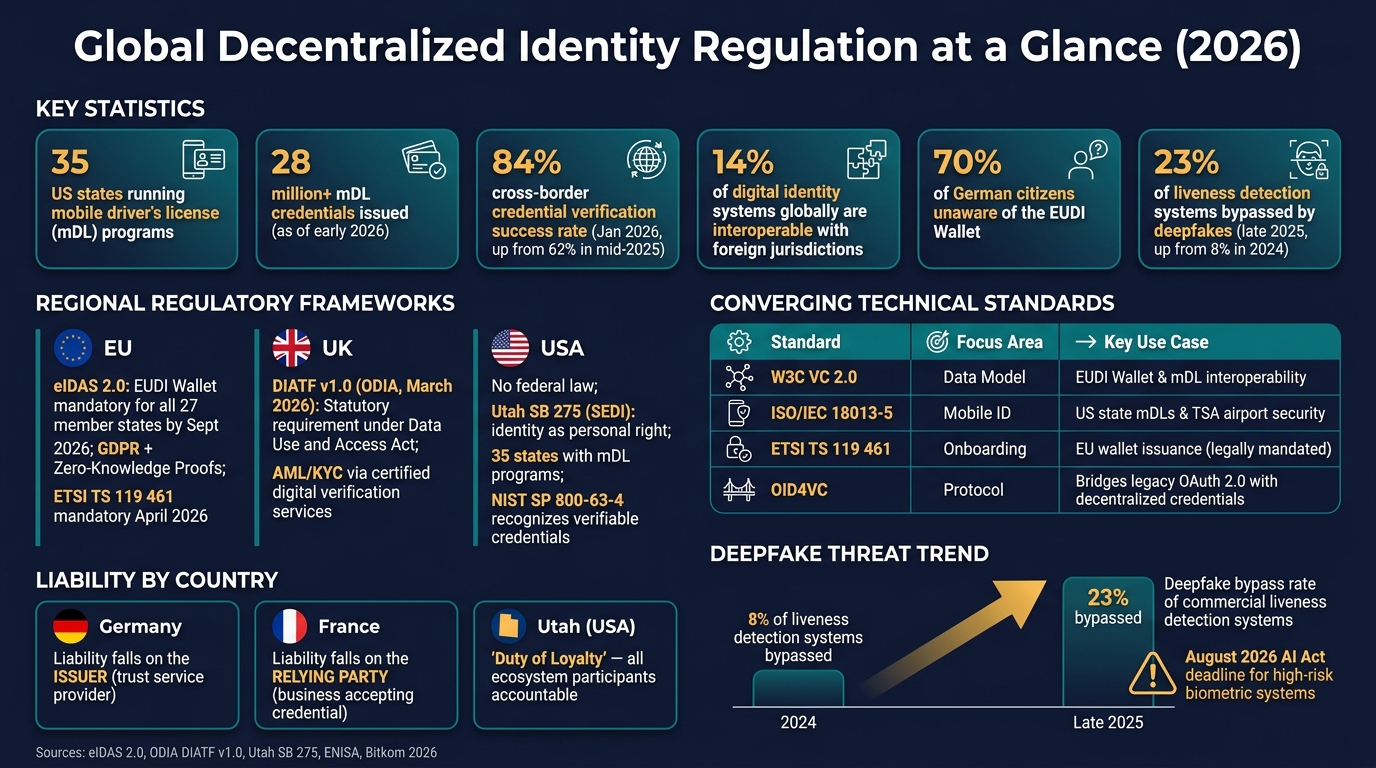
In contrast, the United States lacks a unified federal privacy law, leaving states to pave their own way. Utah’s SB 275, enacted in February 2026, introduced the State-Endorsed Digital Identity (SEDI) program, emphasizing that identity is a personal right, not state-granted. Meanwhile, California’s mobile driver’s license (mDL) initiative is part of a broader trend, with 35 states now running mDL programs and issuing over 28 million credentials as of early 2026.
A pressing legal question across jurisdictions involves a Dutch Supreme Court referral to the Court of Justice of the EU (CJEU). The court is determining whether ID photos should be classified as "special category personal data" under GDPR Article 9. If ruled as such, organizations storing ID copies may need to rethink their legal basis for doing so.
"This is one of the most consequential CJEU referrals in the digital identity space in years… the answer… could reshape data protection compliance for virtually every organisation that stores identity document copies." – Liudmyla (Mila) Rabchynska, Director of Global Regulatory & Government Affairs, IDnow
Trust Frameworks and Digital ID Programs
Privacy laws are just one piece of the puzzle. Trust frameworks are critical for making digital identity systems scalable and functional. They define key roles – like who issues credentials, who verifies them, and who is accountable when issues arise.
The EU’s eIDAS 2.0 is a bold example, requiring all 27 member states to provide a EUDI Wallet by September 2026. Progress has been promising: cross-border credential verification success rates climbed from 62% in mid-2025 to 84% by January 2026. However, only 14% of digital identity systems globally are interoperable with foreign jurisdictions, creating hurdles for businesses operating internationally and leaving liability questions unresolved.
Spain’s MiDNI app, introduced in April 2026, added digital ID functionality to in-person interactions at banks, hotels, and public offices via dynamic QR codes. However, it initially lacked support for e-signatures and travel documents, limiting its utility.
The UK charted its own course. In March 2026, the Office for Digital Identities and Attributes (ODIA) released the Digital Identity and Attributes Trust Framework (DIATF) v1.0, transitioning it from a voluntary program to a statutory requirement under the Data (Use and Access) Act. This development allowed UK businesses to meet Anti-Money Laundering (AML) requirements using certified digital verification services.
"The DVS-to-AML confirmation is the commercial unlock the market has been waiting for: for the first time, a UK regulated business can satisfy an AML identity check requirement by pointing to a certified digital verification service." – Liudmyla (Mila) Rabchynska, Director of Global Regulatory & Government Affairs, IDnow
Interoperability and liability remain significant challenges, particularly for multinational companies navigating compliance across borders.
AML and KYC Compliance Challenges
Decentralized identity introduces unique challenges for industries bound by Anti-Money Laundering (AML) and Know Your Customer (KYC) regulations. AML rules often require storing full copies of identity documents, while GDPR emphasizes collecting only what’s necessary. These conflicting requirements can create compliance headaches.
Reusable KYC credentials are emerging as a solution. With this approach, users are verified once, and their verified credentials are stored in their digital wallets for use across multiple services. Both the UK’s ODIA and the EU’s Anti-Money Laundering Authority (AMLA) are working toward this model. AMLA is also developing unified Regulatory Technical Standards (RTS) that will apply across financial and non-financial sectors, potentially simplifying compliance.
Liability, however, is a sticking point. Responsibility for credential misuse varies by country. In Germany, it typically falls on the issuer, while in France, the relying party – the business accepting the credential – bears the burden. Multinational organizations must carefully monitor these variations as eIDAS 2.0 implementation continues.
Security risks are another concern. Deepfakes are becoming a growing threat. In late 2025, ENISA testing revealed that 23% of commercial liveness detection systems could be bypassed using off-the-shelf deepfake tools, up from just 8% in 2024. For businesses relying on biometric KYC methods, hardware-backed solutions like near-infrared sensors offer a more secure alternative. These vulnerabilities highlight the need for ongoing regulatory updates to keep pace with technological advancements in decentralized identity systems.
sbb-itb-5a89343
Emerging Trends and What They Mean
Standardization of Technical Frameworks
Technical standards have shifted from optional guidelines to binding legal requirements. In April 2026, the European Commission implemented CIR (EU) 2026/798, making the ETSI TS 119 461 standard mandatory for all remote onboarding processes tied to the EUDI Wallet across EU member states. This means businesses must now meet this standard to stay compliant with remote identity proofing regulations.
Three major standards are converging to address the long-standing fragmentation in digital identity systems:
- W3C Verifiable Credentials 2.0: Establishes a data model foundational to the EUDI Wallet and mobile driver’s license (mDL) interoperability.
- ISO/IEC 18013-5: Provides the technical framework for mobile IDs, including U.S. state-issued mDLs and TSA airport security applications.
- OpenID for Verifiable Credentials (OID4VC): Bridges older OAuth 2.0 systems with modern decentralized credentials, enabling businesses to upgrade without overhauling their infrastructure.
| Standard | Focus Area | Regulatory Influence |
|---|---|---|
| W3C VC 2.0 | Data Model | Foundation for EUDI Wallet and mDL interoperability |
| ISO/IEC 18013-5 | Mobile ID | Standard for US state mDLs and airport security (TSA) |
| ETSI TS 119 461 | Onboarding | Legally mandated for EU wallet issuance as of April 2026 |
| OID4VC | Protocol | Bridging legacy OAuth 2.0 with decentralized credentials |
In the U.S., NIST SP 800-63-4 has officially recognized verifiable credentials as a mainstream option for identity proofing, marking a significant step forward for their adoption.
While these standards simplify the technical landscape, they also introduce governance challenges that businesses must navigate carefully.
Governance Models and Liability Distribution
One of the biggest hurdles in trust frameworks is determining who’s liable when issues arise. Different countries have taken very different approaches, making global compliance a complex task.
Take Germany and France as examples. Germany assigns liability to the issuing trust service provider, shielding businesses that rely on the credentials from legal risk. In contrast, France holds the relying party – the business accepting the credential – responsible for any transaction-related issues. For companies operating across borders, understanding these distinctions is crucial for managing risk effectively.
In March 2026, Utah introduced a new approach with its SEDI law. It applies a "duty of loyalty" to all participants in the digital identity ecosystem, including issuers, wallet providers, and verifiers. Legal experts Neil Richards and Woodrow Hartzog advocate for this model to be adopted more broadly:
"A duty of loyalty framed in terms of the best interests of digital consumers is coherent and desirable and should become a basic element of US data privacy law."
For businesses, this means that before issuing or accepting digital credentials, it’s essential to map out the applicable regulatory framework and define clear roles and liability limits in a formalized trust framework.
While liability frameworks are becoming clearer, user adoption depends heavily on addressing consent and usability issues.
User Consent and Usability Challenges
Decentralized identity systems face a major hurdle: user awareness and ease of use. A Bitkom survey from 2026 revealed that 70% of German citizens either have no knowledge of the EUDI Wallet or cannot explain what it is. This lack of awareness directly impacts how quickly businesses can onboard users and predict adoption rates.
Usability challenges are summed up perfectly by Utah’s Chief Privacy Officer, Christopher Bramwell:
"Whoever controls the key controls the identity."
This highlights both the power and the problem of decentralized systems. While they give users full control, losing access to a device without a recovery solution could mean losing access to their entire digital identity. To address this, developers are working on solutions like hardware security modules (HSMs) and encrypted cloud-based vaults. However, widespread, user-friendly recovery options remain a work in progress.
Advances like Zero-Knowledge Proofs now allow privacy-preserving age verification in under half a second. The challenge lies in ensuring wallet providers implement these tools effectively. For example, users should be able to confirm they’re "over 18" without sharing unnecessary personal details or an entire credential. Solving these usability issues will be key to driving broader adoption of decentralized identity systems.
Practical Compliance Strategies for Businesses and Users
Building Privacy-First Decentralized Identity Systems
When designing decentralized identity systems, deciding where to store data is a pivotal step. Cryptographic keys, like decentralized identifiers (DIDs), should be anchored on-chain, while identity data should remain stored locally to align with GDPR requirements. It’s equally important to evaluate wallet solutions for features like selective disclosure and ensure compliance with regulations like the SEDI law by avoiding tracking mechanisms.
Deepfake risks are another pressing concern. To address this, businesses can adopt hardware-backed liveness detection systems, which provide an added layer of security against advanced impersonation threats. While technical innovations continue to emerge, traditional safeguards still play a critical role in maintaining trust.
The Role of SMS Verification During the Transition
The decentralized identity ecosystem is still in its early stages. For now, SMS-based verification serves as a practical bridge until digital wallets become widespread. The EUDI Wallet’s December 2026 deadline is better understood as a coordination milestone rather than a strict cutoff. As Liudmyla Rabchynska, Director of Global Regulatory & Government Affairs at IDnow, explains:
"The December 2026 deadline is working as a coordination mechanism more than a hard delivery date… the market for EUDI Wallet-integrated services won’t be at scale in 2026, it will begin to emerge through 2027."
SMS verification remains a user-friendly option, familiar to most people, ensuring smoother onboarding while the digital wallet infrastructure matures. For businesses complying with AML and KYC regulations, the type of SMS verification matters. Non-VoIP, SIM-card-based numbers offer stronger identity assurance than VoIP alternatives because they are tied to physical SIMs and real carriers. This aligns with the "Substantial" or "High" Levels of Assurance outlined in ETSI TS 119 461.
For users concerned about protecting their phone numbers during this transition, services like MobileSMS.io provide disposable, real SIM-based numbers. These numbers are widely accepted by major platforms like Google, WhatsApp, and Telegram, boasting a 99.7% platform acceptance rate. Unlike VoIP numbers, these SIM-based options ensure higher reliability and compliance.
Balancing Compliance with User Experience
While SMS verification plays a key role during this transitional period, improving the user experience is just as important. High rates of onboarding abandonment often stem from overly complex verification processes. The solution isn’t to relax compliance standards but to create smarter, more user-friendly verification flows. For example, Zero-Knowledge Proofs allow privacy-preserving age verifications that meet regulatory requirements without adding unnecessary friction.
A practical step for businesses is to maintain fallback options. Not all users have access to compatible smartphones, and digital wallet infrastructure isn’t uniformly available across regions. Removing traditional verification methods, like physical ID checks or SMS-based verification, risks alienating a sizable portion of the user base. By continuing to support these legacy options alongside wallet-based systems – at least until 2027 – businesses can ensure inclusivity and adapt to current market conditions.
Conclusion and Future Outlook
Key Takeaways from Current Trends
Decentralized identity regulation is now guided by frameworks like eIDAS 2.0, DIATF v1.0, and the SEDI law, which emphasize user empowerment, reduced data collection, and holding organizations accountable. These frameworks are reshaping the digital identity landscape by prioritizing user-centric principles.
The shift toward mandatory privacy-by-design is another major development. Standards like W3C Verifiable Credentials 2.0 and ETSI TS 119 461 have become essential benchmarks. Adding to this, the emerging concept of a "duty of loyalty" is changing expectations for identity providers, legally requiring them to prioritize users’ best interests.
"Adoption of a duty of loyalty would be ‘a revolution in data privacy law.’" – Neil Richards and Woodrow Hartzog, Legal Scholars
These trends underline the importance of staying informed and proactive. As these regulations and standards evolve, they will continue to shape the relationship between users, platforms, and regulators.
Areas for Further Research and Monitoring
While progress is evident, there are still unresolved challenges. For example, cross-border verification has improved significantly – rising from a 62% success rate in mid-2025 to 84% by January 2026. However, the remaining 16% failure rate poses a serious hurdle for global operations, especially for multinational businesses. Achieving seamless interoperability between the EU’s EUDI Wallet ecosystem and systems in non-EU regions remains a critical area for further study.
Public awareness is another pressing issue. As of April 2026, only 52% of German citizens were familiar with the EUDI Wallet. This gap highlights the need for businesses to align technological advancements with public understanding, particularly when designing wallet-based onboarding processes.
Finally, businesses should keep a close eye on the August 2026 AI Act deadline for high-risk systems, such as biometric verification tools. Recent data shows that 23% of commercial liveness detection systems were bypassed by deepfakes in late 2025. With compliance deadlines looming, companies must act swiftly to address vulnerabilities and strengthen their systems.
FAQs
What does eIDAS 2.0 change for U.S. businesses with EU customers?
eIDAS 2.0 updates the European digital identity framework, focusing on better security, seamless interoperability, and greater user control. It introduces decentralized identity models, including Self-Sovereign Identity (SSI), and bolsters privacy safeguards.
For U.S. businesses, this brings both challenges and opportunities. Companies will need to align with these new standards to remain compliant and deliver smooth services. At the same time, this harmonized system simplifies cross-border interactions with EU customers and partners, streamlining operations and fostering trust in digital transactions.
How do AML/KYC rules align with GDPR’s data-minimization requirements?
AML (Anti-Money Laundering) and KYC (Know Your Customer) regulations require organizations to verify identities, while GDPR focuses on limiting the collection of personal data. Decentralized identity solutions, such as Self-Sovereign Identity (SSI), tackle this challenge by enabling users to share only the credentials that are absolutely necessary. Tools like zero-knowledge proofs take privacy a step further by minimizing the amount of data exposed during verification processes. Additionally, decentralized storage systems provide stronger privacy protections. Together, these methods allow organizations to meet AML/KYC standards while respecting GDPR principles, creating a more secure and privacy-conscious digital landscape.
Who is liable if a verifiable credential is misused across borders?
Liability for the cross-border misuse of a verifiable credential largely hinges on the legal and regulatory frameworks in place. In most cases, the responsibility falls on the issuer or the entity managing the credential. Newer regulations, like eIDAS 2.0, are being developed to provide clearer guidelines and foster greater trust and accountability in these situations.