

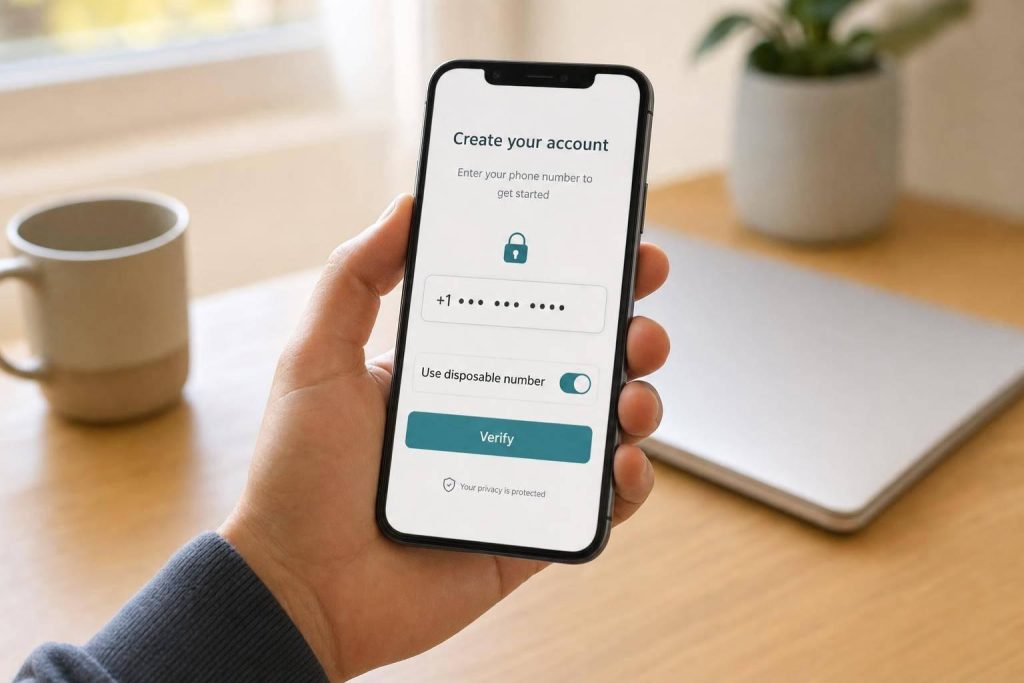
Your phone number can become your weakest login detail. If one company leaks it, attackers can use that same number to map your accounts, send scam texts, try password resets, or attempt a SIM-swap attack.
Here’s the short version:
- One phone number ties many accounts together
- A breach can turn that number into a long-term target
- Disposable numbers help cut the link between you and low-trust sign-ups
- One-time numbers fit short-term use
- Renewable rentals fit accounts that may need SMS again later
- For banks and government accounts, I’d keep using my main number with stronger login protection
The risk is not small. In 2023, data breaches exposed more than 1.35 billion records, and the FBI logged over 2,000 SIM-swap complaints with more than $72 million in losses. That’s why I’d avoid using my personal number for free trials, dating apps, marketplace accounts, and other sign-ups that don’t need it.
If I want one simple rule, it’s this: I use my real number only where recovery and identity checks matter most, and I use a disposable number for everything else.
The problem: personal phone numbers expose too much data during routine sign-ups
Once your phone number is out there, it can turn into a long-term target for linking, tracking, and abuse. It’s not just a tool for getting a text receipt. It’s a stable identifier tied to your identity, carrier records, and account history. And the risk jumps when a sign-up doesn’t even need your real number in the first place.
Sign-up situations where sharing your real number carries high risk
Not every sign-up should get your real number. Some cases carry a lot more risk than others:
- High-visibility consumer apps – Social media, dating, and content platforms can connect your number to personal photos, location patterns, and behavior data that may be exposed or sold.
- High-value financial accounts – Crypto exchanges and finance platforms make phone numbers a top target for SIM swap attacks, where taking control of your number can mean taking control of your funds.
- Temporary or low-trust sign-ups – Free trials and one-time services may still keep your number in their databases long after you cancel, and that data can be monetized or passed to data brokers.
The issue gets worse when you use the same number again and again across different services.
Why reusing one number across platforms makes tracking and account linking easier
Using one number across many platforms makes account linking much easier for platforms, brokers, and attackers. If the same number shows up across unrelated services, it gives those parties a simple way to connect your accounts into one profile.
Attackers use this too. Through password-reset flows, they can test which services are tied to your number and then go after the ones that matter most. One exposed number can put banking, work, and social accounts at risk at the same time. A reusable number becomes a single point of failure. The more places it appears, the larger the blast radius.
sbb-itb-5a89343
The solution: disposable numbers isolate sign-ups and limit breach damage
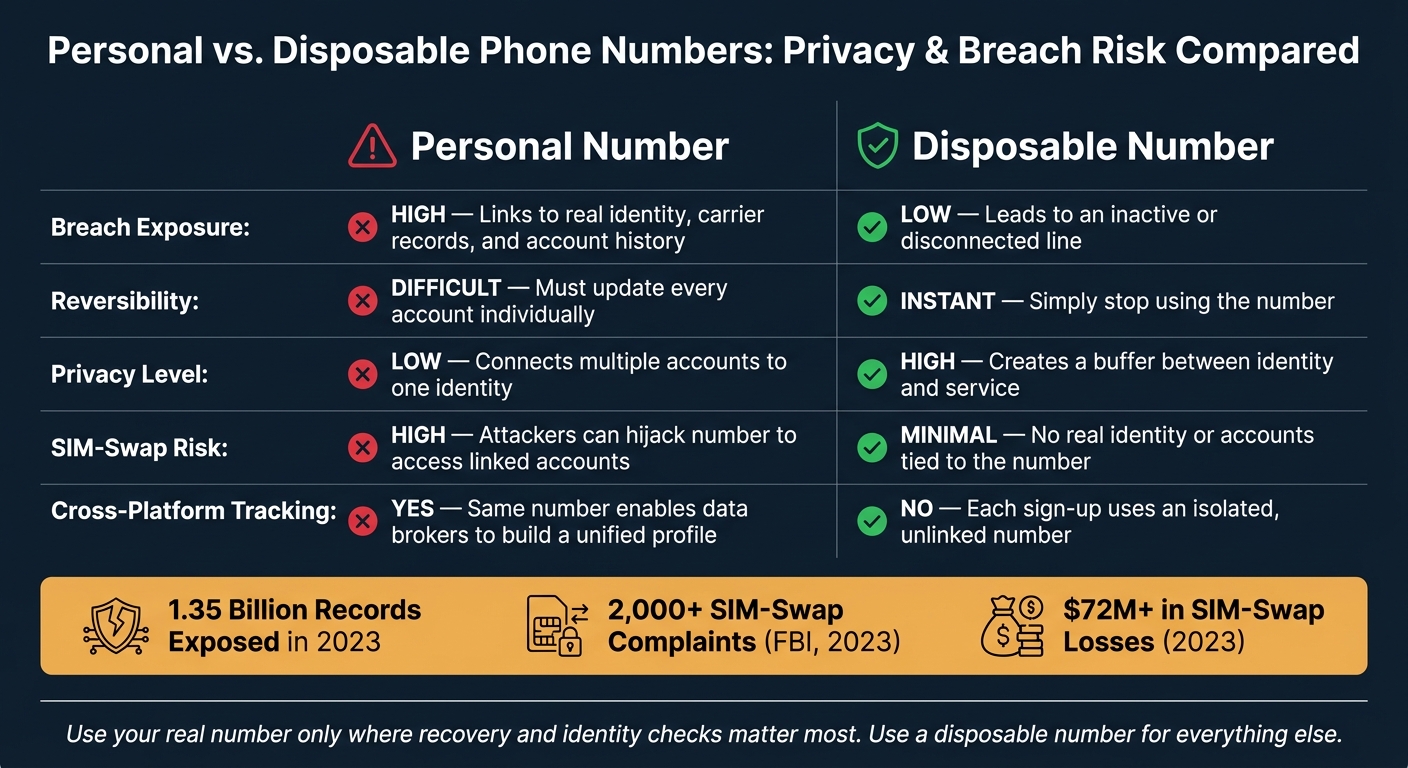
Personal vs. Disposable Phone Numbers: Privacy & Breach Risk Compared
A disposable number keeps your real number out of a sign-up database. Instead of giving an app your personal line, you use a one-time number for SMS verification and then toss it. Simple.
That cuts down the data tied to you and keeps accounts from being linked through one permanent phone number. So rather than handing the same identifier to every service that asks, you use the number once, verify the account, and move on.
How disposable numbers work for SMS verification and one-time passwords
The process is straightforward: pick a number, enter it in the sign-up form, and then check the provider’s dashboard for the one-time password (OTP) when it comes in.
If that number is exposed later, it isn’t tied to you or your device. That means spam, smishing, and follow-up abuse hit a dead end.
Why real SIM-based, non-VoIP numbers get accepted on strict platforms
This only works if the platform accepts the number in the first place.
Many strict services check whether a number belongs to a real mobile line. VoIP numbers often get flagged or blocked because they’re easy to create at scale and are often linked to bot sign-ups.
Real SIM-based numbers sit on physical carrier infrastructure. Because of that, they pass carrier checks more often and tend to get through on platforms with tighter verification rules.
Personal number use vs. disposable number use: a side-by-side comparison
Here’s the practical difference at a glance:
| Aspect | Personal Number Use | Disposable Number Use |
|---|---|---|
| Breach Exposure | High; connects to real identity and carrier records | Low; leads to an inactive or disconnected line |
| Reversibility | Difficult; requires updating each account with a new number | Instant; simply stop using the number |
| Privacy Level | Low; connects multiple accounts to one identity | High; creates a buffer between your identity and the service |
How to use disposable numbers in practice for safer account creation
When a one-time number is enough and when a longer rental makes more sense
The best option comes down to one thing: how long the account may need to receive SMS messages.
Use a one-time number or a renewable rental based on whether the account may ask for SMS again later.
A one-time number fits low-stakes sign-ups well, like starting a free trial or joining a marketplace you plan to use for a short time. You receive the code, finish the setup, and that’s it.
A renewable rental makes more sense when the account may ask for the same number again. Password resets, two-factor authentication prompts, and re-verification checks often depend on the number used at sign-up. If that number is no longer yours, you could get locked out for good. For business accounts or main social profiles, a renewable rental helps keep that line open.
If an account needs long-term access, verify it once with a disposable number for account verification and then move to an authenticator app.
Using MobileSMS.io for secure sign-ups across major platforms
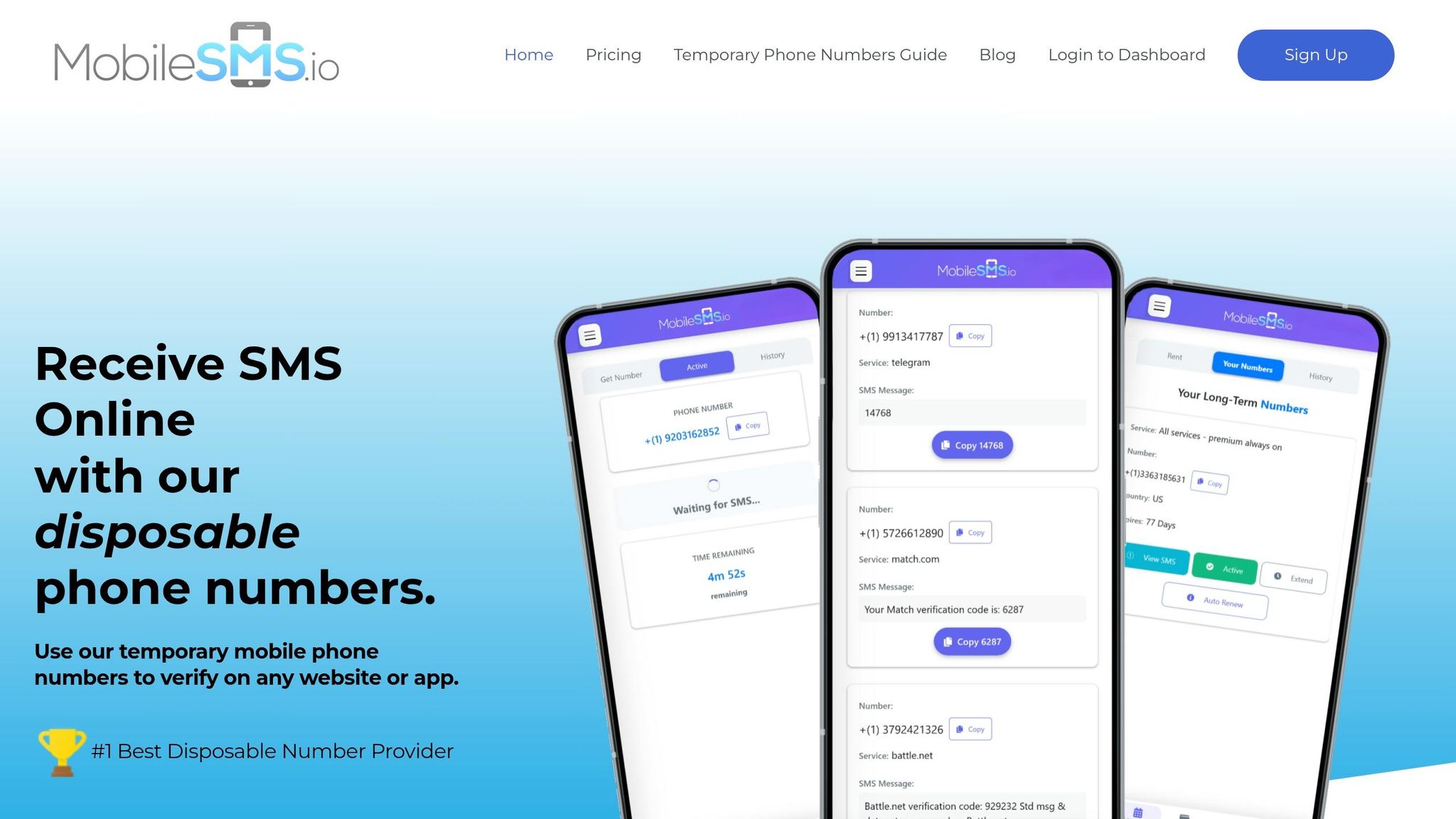
For the verification step itself, use a provider that offers real SIM-based numbers.
MobileSMS.io supplies real SIM-based numbers for verification on major platforms.
Match the number type to the sign-up scenario
| Sign-Up Scenario | Risk Level | Recommended Number Type | Typical Duration |
|---|---|---|---|
| One-time trial services | Low | One-time disposable | Under 30 minutes |
| Long-term business accounts | High | Renewable rental | Monthly/Ongoing |
| Marketplace accounts (e.g., eBay, Craigslist) | Medium | One-time or short rental | 1 day to 1 month |
| International sign-ups | Medium | One-time, country-matched – use a number from the account’s target region to avoid verification failure | Under 30 minutes |
| Privacy-sensitive profiles (dating, social media) | High | Renewable rental | Ongoing |
Conclusion: keep your personal number private to reduce your breach exposure
Once you’ve picked the right type of number, the main point is pretty clear: data breaches exposed over 1.35 billion records in 2023, and phone numbers were among the identifiers stolen most often.
Use your real number only where account recovery and trust matter most. Think banks and government services. For everything else, a disposable phone number helps keep your main line out of databases you don’t control. If a service gets breached, the leaked record leads to a temporary number, not your actual line.
That separation helps contain the damage from a single breach. It also cuts down on spam, limits cross-platform tracking, and lowers your risk of SIM-swap fraud. The FBI reported over 2,000 SIM-swap complaints in 2023, with losses above $72 million.
It also helps to keep personal and work sign-ups separate. The fewer services that store your real number, the less damage a breach can do.
FAQs
Are disposable numbers legal for sign-ups?
Yes. Using disposable numbers for online sign-ups is a legal way to protect your privacy. They create a temporary buffer between your personal phone number and the sites or apps you use.
That said, each platform can still decide which numbers it accepts under its own terms. But the tech itself is legitimate, and it can help cut down on spam, lower your exposure in a data breach, and make it harder for companies to track your identity across platforms.
Can I lose access to an account if I use a one-time number?
Yes. You can lose access if the platform flags the disposable number as fraud or if you need that number later for account recovery or two-factor authentication.
Some platforms block non-SIM-based numbers. If the number is blacklisted, you could end up locked out for good. If you need steady access to an account, a long-term renewable number is a safer choice than a one-time number.
Which accounts should still use my real phone number?
Save your real phone number for private, high-stakes services where identity checks are legally or practically required. That usually means your main bank, tax paperwork, medical records, government portals, and emergency contacts or close family.
Think of it like a house key you wouldn’t hand out to every store clerk or website. The less you share it with businesses, websites, and public-facing platforms, the lower your risk of data breaches, SIM swapping, and spam.