

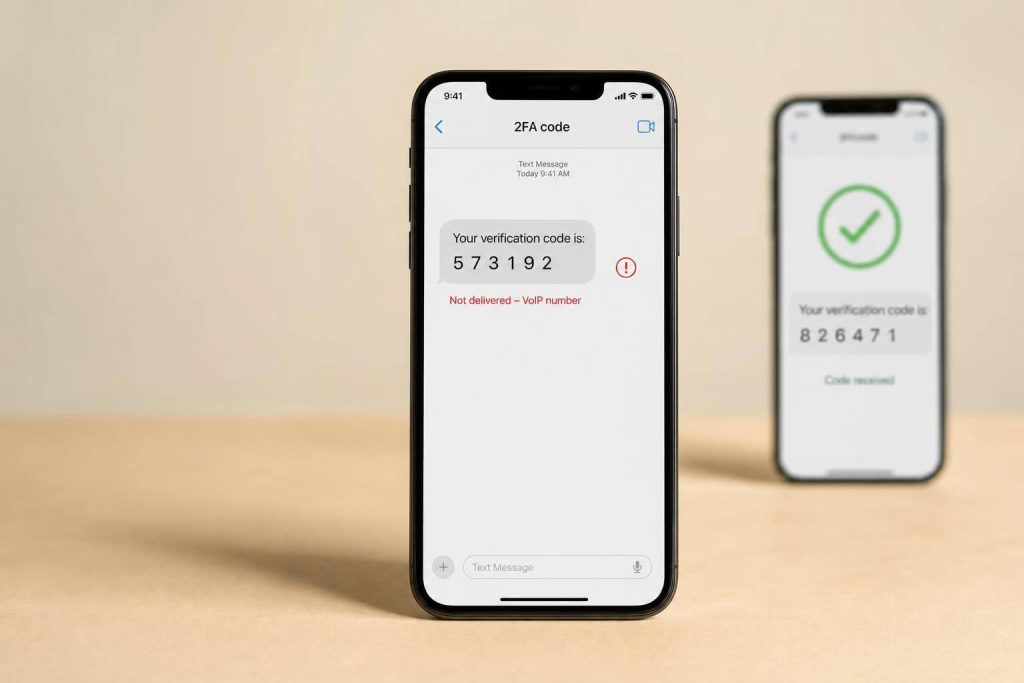
If your SMS login code never arrives on a VoIP number, the platform may have blocked the number before sending anything.
I’d sum it up like this:
- Many sites check your number type first
- If the lookup says VoIP, the code may be stopped right away
- Banks, crypto apps, social apps, and marketplaces often filter VoIP more hard than low-risk sites
- Even when VoIP isn’t blocked, delivery can be late or fail
- A SIM-based mobile number tends to pass more often because it shows up as mobile, not VoIP
- If privacy matters, a one-time or rental SIM number can keep your personal number off the account
That’s the whole issue in plain English: SMS verification is not just about sending a text. It’s also about whether the number passes a risk check. In many cases, the failure happens before the message queue, which is why you may see “code sent” even when no text was sent at all.
A lot of platforms sort numbers into groups like mobile, VoIP, landline, or unknown. Once a number is marked as VoIP, it can get a lower risk score. That leads to blocked sign-ups, failed account recovery, and “try again later” cooldowns after repeated attempts.
Quick comparison
| Check | VoIP number | SIM-based mobile number |
|---|---|---|
| Carrier lookup result | VoIP / Virtual | Mobile |
| Chance of getting blocked | Higher | Lower |
| OTP delivery stability | Less steady | More steady |
| Ownership signal | Weaker | Stronger |
| Best use case | Calls, low-risk use | SMS verification and account recovery |
So if I were giving the short answer, it would be this: VoIP fails SMS 2FA because platforms often don’t trust it, and using real SIM-card phone numbers fixes that more often than not.
sbb-itb-5a89343
Why Platforms Block VoIP Numbers for SMS Verification
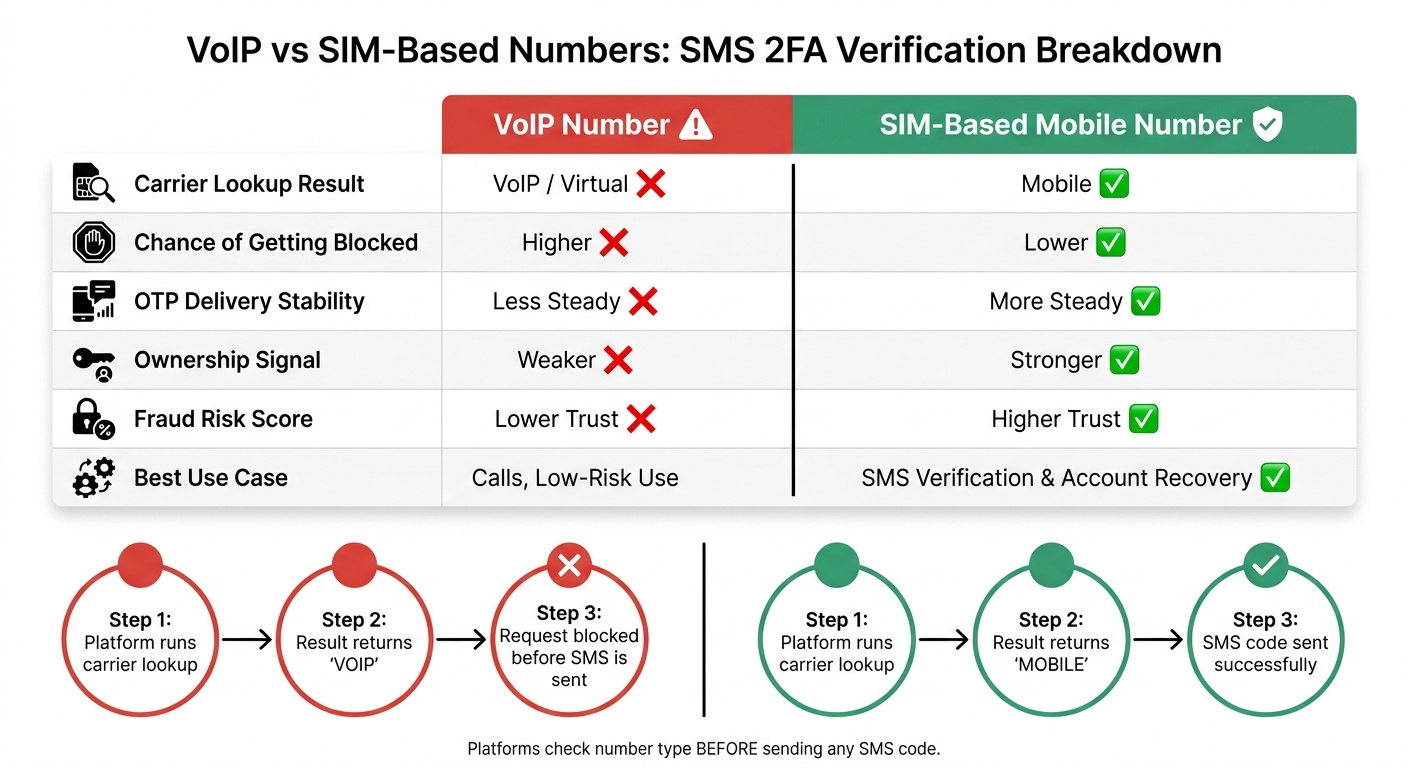
VoIP vs SIM-Based Numbers: SMS 2FA Verification Breakdown
When your SMS code never shows up, it’s easy to blame the message delivery. But a lot of the time, the issue starts earlier. The platform chose not to send the code at all.
The big thing here is trust. A platform first decides whether a number looks safe enough for verification. If it doesn’t, the SMS request gets stopped before anything goes out.
Fraud Prevention Drives VoIP Blocks
VoIP blocks exist to limit fraud, not to fix delivery issues. VoIP numbers are often easier to get and cycle through, which makes them useful for fake account creation, spam bots, and scam systems that run at scale.
So platforms block VoIP ranges as a simple way to shut down that path before it turns into a bigger problem. From their side, it’s less about one person missing a code and more about stopping abuse in bulk.
Banks, Social Apps, and Marketplaces Apply Stricter Filters
High-risk services – especially banks, crypto apps, messaging apps, and social platforms – tend to use tighter VoIP filters because fake accounts can lead to direct losses.
That makes sense when you think about it. A fake account on a casual site is one thing. A fake account tied to money, identity, or mass messaging is a whole different mess.
VoIP Rejection Is a Policy Decision, Not a Delivery Error
This filter usually happens before delivery, which is why the failure can look like a messaging problem. In many cases, the platform still shows a “code sent” message even though nothing was dispatched.
Here’s what often happens behind the scenes:
- The platform runs a carrier lookup.
- The lookup returns
VOIP. - The system drops the request before sending the SMS.
That silent failure is on purpose. Platforms use real-time carrier lookups to intercept the request before any message gets queued. If the line type comes back as VoIP, the block happens at the verification layer, not at the network layer.
And if you keep retrying the same blocked VoIP number, you may hit rate limits. That’s when you start seeing messages like “Too many attempts” or “Try again later.” Those aren’t delivery failures either. They’re risk-based cooldowns meant to slow automated abuse.
The next layer is technical: VoIP routes also fail verification more often.
Technical Reasons SMS 2FA Fails on VoIP
OTP Delivery Fails More Often on VoIP Routes
Even if a platform doesn’t flat-out block a VoIP number, SMS delivery can still be shaky.
Carrier SMS routes are usually faster and more consistent than internet-based VoIP delivery. VoIP routes tend to be less reliable, which means OTPs can show up late or never arrive at all.
And there’s another layer to it: even when the message does land, a VoIP number can still look less trustworthy to a verification system.
VoIP Numbers Carry Weaker Ownership Signals
Delivery is only part of the issue. Trust signals matter just as much.
VoIP numbers are easy to create and recycle, so fraud systems treat them as weaker identity signals than SIM-based mobile numbers. A carrier-issued number usually has a longer account history, plus a line tied to a physical SIM. To a fraud engine, that looks very different from a number created minutes before sign-up.
That weaker signal doesn’t stop at registration either. It can stay attached to the account after sign-up.
Real SIM numbers deal with both problems at once: they tend to deliver more reliably, and they send stronger trust signals. VoIP is easier to provision and less trusted. Real SIM numbers are tied to carrier-issued lines and pass verification more often. That’s why SIM-based numbers get through verification more reliably.
How Real SIM-Based Numbers Fix VoIP 2FA Failures
Why Carrier-Issued Numbers Pass More Verification Checks
When VoIP fails a trust check, a real SIM number gives platforms the signal they expect to see.
Carrier-issued SIMs usually return "MOBILE" when a platform checks your number’s carrier type. A VoIP number, on the other hand, often shows up as "VOIP" or "VIRTUAL". That alone makes it more likely to get blocked before the code is even sent.
The network type also plays a part. Real SIM numbers move through carrier network signals that verification systems recognize as normal consumer lines. VoIP numbers are easier to recycle, so they often come with a weaker trust history.
That’s why real SIM numbers tend to pass more often: they line up with the carrier patterns verification systems are built to accept.
Where MobileSMS.io Fits
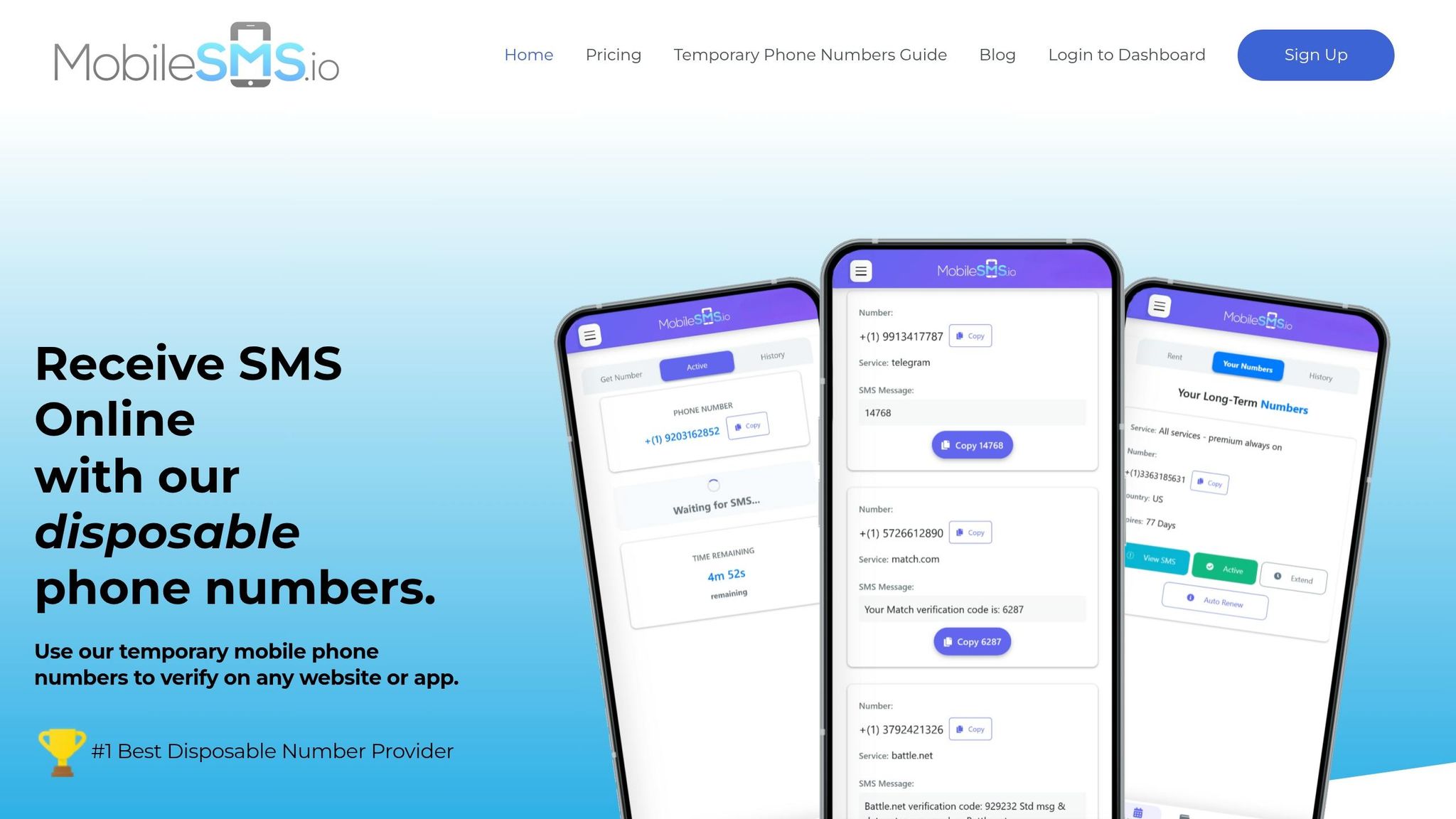
When verification depends on carrier trust, real SIM-based numbers are the practical fix.
MobileSMS.io offers real SIM-card, non-VoIP numbers made for SMS verification. One-time disposable numbers start at $3.50 for a single verification. If you need access over time, long-term rentals range from $15 to $100 per month. Billing is pay-per-success, so you’re only charged when a code is actually received.
When a Disposable Number Works Better Than Your Personal Line
This matters most when privacy or account separation is the goal.
Each platform you verify with adds your number to its records. Those records can be exposed in a data breach or scraped. A disposable real SIM number keeps your personal line out of that loop.
It also helps if you manage multiple accounts across e-commerce platforms or social media. Separate SIM-based numbers with isolated histories can reduce the account conflicts that a single personal number might trigger.
For short-term access to a service, a one-time number is a simple option. You get no personal number exposure, fewer account conflicts, and no long-term commitment.
Conclusion: If VoIP SMS 2FA Keeps Failing, Switch to a Real SIM Number
VoIP numbers often fail SMS 2FA for three main reasons: platforms block them, message delivery can be shaky, and their trust signals are weaker than those of real SIM numbers. Real SIM numbers work more often because they fit the carrier type and account signals that platforms look for.
For sign-ups, account recovery, and other SMS checks, a real SIM number is usually the safest bet. If an account may ask for verification again later, a long-term rental can keep access steady without linking the account to your personal number. If you only need to verify once, a disposable real SIM number is often enough.
MobileSMS.io provides real SIM-based, non-VoIP numbers for SMS verification. One-time numbers start at $3.50. Long-term rentals range from $15 to $100 per month. It also uses pay-per-success billing. If VoIP keeps failing, the fix is simple: use a real SIM number.
FAQs
How can I tell if my number is VoIP?
Use a carrier lookup service to check your number’s metadata in real time.
The key field is line_type. If it shows VoIP, virtual, or fixed VoIP, the number runs over the internet and may get blocked by platforms that ask for a mobile number. If it shows mobile or wireless, the number is linked to a cellular carrier.
Why does a site say "code sent" if nothing was sent?
Usually, the platform runs a carrier lookup on your number before it sends the SMS. If that lookup marks the number as VoIP, the platform may block the request or just drop it without saying anything.
That’s why this can feel so confusing. A lot of sites don’t show an error at all, so the screen still says "code sent" even though no message was ever sent.
Should I use a disposable SIM or a long-term rental?
It depends on how you plan to use the account.
Pick a disposable number if you only need a one-time SMS verification. It’s the simple option for a one-and-done signup.
If there’s any chance you’ll need that number again for security checks, re-logins, or account recovery, a long-term rental is the safer choice. It gives you more control over the number and can help you avoid getting locked out later.